
Zur Startseite Zur Hauptnavigation Zum Inhalt Zur Sitemap
+A-
ENDE
  menu
Institut für Physiologie II - Herz-Kreislauf-Physiologie
  menu
  • Staff
  • Research fields
    • Sodium channels
    • HCN channels
    • P2X channels
    • Glutamate receptors (GPCR)
    • Metabotropic glutamate receptors (GPCR)
    • Concentration Clamp
    • Kv Channels
    • Modeling of ion channels
    • Acetylcholine receptors
    • The voltage sensor in CNG channels
    • CNG channels
    • The selectivity filter gate of potassium channels
  • Collaborative Funding
  • Methods
  • Publications
  • Jobs
  • How to contact us
  • Main menu
    • Patients & Relatives
    • Research
    • Teaching and study
    • Doctors & Referrers
    • Clinics & Institutes
    • Careers
    • University Hospital
  • Staff
  • Research fields
    • Sodium channels
    • HCN channels
    • P2X channels
    • Glutamate receptors (GPCR)
    • Metabotropic glutamate receptors (GPCR)
    • Concentration Clamp
    • Kv Channels
    • Modeling of ion channels
    • Acetylcholine receptors
    • The voltage sensor in CNG channels
    • CNG channels
    • The selectivity filter gate of potassium channels
  • Collaborative Funding
  • Methods
  • Publications
  • Jobs
  • How to contact us
Physiology / Research fields / Metabotropic glutamate receptors (GPCR)

Metabotropic glutamate receptors (GPCR)

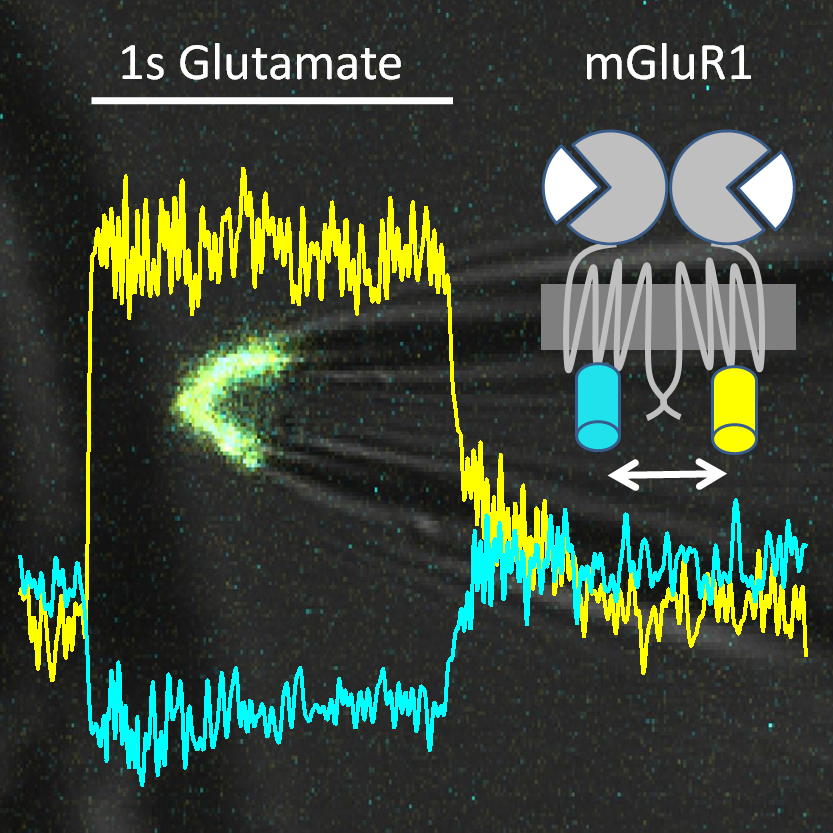
mGluR1- E-sensor contains CFP and YFP in the second intracellular loop. Upon ligand binding the two subunits move closer to each other and more signal is transfered from CFP (cyan) to YFP (yellow curve).

GPCR-Dynamics (mGuR1)

G-protein-coupled receptors (GPCR) are membrane receptors. GPCR can sense stimuli such as light, odorants, hormones, mechanical impulses and neurotransmitter. These stimuli are transduced into cellular signaling cascades. GPCR are an important pharmacological target. Of the drugs with known molecular target every third affects one of the about 800 human GPCRs (~ 4% of all genes).

We are investigating ligand-induced conformational dynamics of GPCR on the example of the metabotropic glutamate receptor mGluR1. mGluR1 senses the neurotransmitter glutamate and influences synaptic long-term potentiation and ultimately learning.

mGluR1 is a homo-dimer. We follow the ligand induced conformational rearrangements between the subunits with FRET, using CFP and YFP inserted in the two subunits as FRET partners. Time resolution is optimized by using electrophysiological methods: solutions in front of small membrane fragments (outside-out patches) are changed with a piezo-driven application system. With this we achieve sub-ms time resolution, at least an order of magnitude faster than good cell-biological assays.


Methods

FRET
Confocal Patch-Clamp Fluorometry

Concentration clamp


Cooperations

Prof. Dr. Carsten Hoffmann

Institut für Molekulare Zellbiologie, Universitätsklinikum Jena


Contact

Dr. Ralf Schmauder

Phone: 03641 - 9 397671

Prof. Dr. Klaus Benndorf

Phone: 03641 - 9 397651

Staff Publications
Research fields Jobs
Collaborative Funding How to contact us
Methods
FSU
VUD