
Zur Startseite Zur Hauptnavigation Zum Inhalt Zur Sitemap
+A-
ENDE
  menu
Institut für Allgemeinmedizin
  menu
  • Homepage
  • Team
  • Research areas
  • Research projects
    • pallCompare
  • Publications
  • Main menu
    • Patients & Relatives
    • Research
    • Teaching and study
    • Doctors & Referrers
    • Clinics & Institutes
    • Careers
    • University Hospital
  • Homepage
  • Team
  • Research areas
  • Research projects
    • pallCompare
  • Publications
Homepage / Research projects / AVENIR

AVENIR

AVENIR – Improving care for sepsis patients: Analysis of healthcare pathways, experiences, and needs of patients with and after sepsis

Funding Period: 09/2022 – 02/2026
Funding Code: 01VSF21031
Funding body: Innovationsfonds

Study Objective

Sepsis is the leading cause of death from infectious diseases, accounting for around 20% of all deaths worldwide. As it can occur alongside any underlying disease and often presents with non-specific initial symptoms, its emergency treatment poses an interdisciplinary and cross-sectoral challenge. Any delay in hospital admission, diagnosis and guideline-based acute therapy is associated with an increased risk of death in hospital, which in Germany is higher than in other industrialised nations. One in three sepsis survivors experiences new cognitive, psychological or physical complications for which there are currently no specific treatment or aftercare programmes.

The AVENIR project aims to improve sepsis care by gaining a better understanding of patient pathways, as well as their subjective experiences and needs throughout the entire care pathway during and after sepsis. Based on this, concrete recommendations for organising care will be developed, as well as patient information materials, with close patient involvement.


Subprojects of the Institute of General Practice

Subproject A: Claims data analysis

This retrospective cohort study uses Germany-wide data on hospitalisations for sepsis between 2016 and 2020, provided by the Scientific Institute of the AOK (WIdO) for insured persons with AOK insurance. Data on the selected study population is available for one year before and two years after the study.

In our subproject, we analyse in detail: (1) the pathway to inpatient care for patients with community-acquired sepsis; and (2) the care of sepsis survivors after discharge from hospital. In each case, defined care indicators and care costs are recorded over specified time periods.


Subproject C: Provider perspective – qualitative survey

A qualitative survey will be conducted using guided expert interviews and interdisciplinary and interprofessional focus groups to record care pathways and experiences from the provider perspective. Healthcare professionals involved in the preclinical, inpatient, and post-hospital treatment of sepsis patients, such as emergency medical technicians, nurses, therapists, and physicians, will be interviewed. The questions to be clarified in this subproject are: (1) What challenges, best practice examples and deficits exist in acute and long-term care after sepsis, particularly during transitions between sectors? (2) What factors influence the detection and adequate care of sepsis? What contributes to early detection and what to delayed detection? (3) To what extent can concrete optimisation proposals for care with and after sepsis be derived from the results?

Project Team

  • PD Dr. rer. pol./habil. med. A. Freytag
  • Dr. rer. nat. B. Ditscheid
  • M.Sc. Lea Draeger
  • Dr. rer. pol. Fabian Dutschkus
  • M.Sc. Josephine Storch
  • Prof. Dr. med. J. Bleidorn

Publications

  • Joost F, Rose N, Kimmig A, Ruhnke T, Dröge P, Freytag A, Günster C, Pletz MW, Roesler M, Reuken PA, Schlattmann P, Schmidt K, Stallmach A, Storch J, Reinhart K, Wedekind L, Fleischmann-Struzek C. Long‑term outcomes after intensive care unit‑treated COVID‑19, influenza and respiratory sepsis in 2020 – a comparative, population‑based cohort study Infection (2025). https://doi.org/10.1007/s15010-025-02644-3 
  • Wedekind L, Rose N, Freytag A, Kimmig A, Schlattmann P, Pletz MW, Ruhnke T, Dröge P, Fleischmann-Struzek C. Rehospitalizations for ambulatory care sensitive conditions in sepsis survivors– a nationwide cohort study using health claims data 2016 – 2019. Infection (2025). https://doi.org/10.1007/s15010-025-02606-9 
  • Ruhnke T, Storch J, Freytag Aet al. Transitional care after hospitalization for sepsis in Germany– results from the population-based AVENIR cohort study. Infection (2025). https://doi.org/10.1007/s15010-025-02589-7 
  • Draeger L, Fleischmann-Struzek C, Gehrke-Beck S, Heintze C, Thomas-Rueddel DO, Schmidt K. Barriers and facilitators to optimal sepsis care – a systematized review of healthcare professionals’ perspectives. BMC Health Serv Res25, 591 (2025). https://doi.org/10.1186/s12913-025-12777-8
  • Draeger L, Fleischmann-Struzek C, Bleidorn J, Kannengiesser L, Schmidt K, Apfelbacher C, Matthaeus-Kraemer C. Healthcare professionals’ perspectives on sepsis care pathways—qualitative pilot expert interviews. J Clin Med14, 619 (2025). https://doi.org/10.3390/jcm14020619
  • Fleischmann-Struzek C, Rose N, Ditscheid B, Draeger L, Dröge P, Freytag A, Goldhahn L, Kannengießer L, Kimmig A, Matthäus‑Krämer C, Ruhnke T, Reinhart K, Schlattmann P, Schmidt K,Storch J, Ulbrich R, Ullmann S, Wedekind L, Swart E. Understanding health care pathways of patients with sepsis: protocol of a mixed-methods analysis of health care utilization, experiences, and needs of patients with and after sepsis. BMC Health Serv Res 24, 40 (2024). https://doi.org/10.1186/s12913-023-10509-4


Results

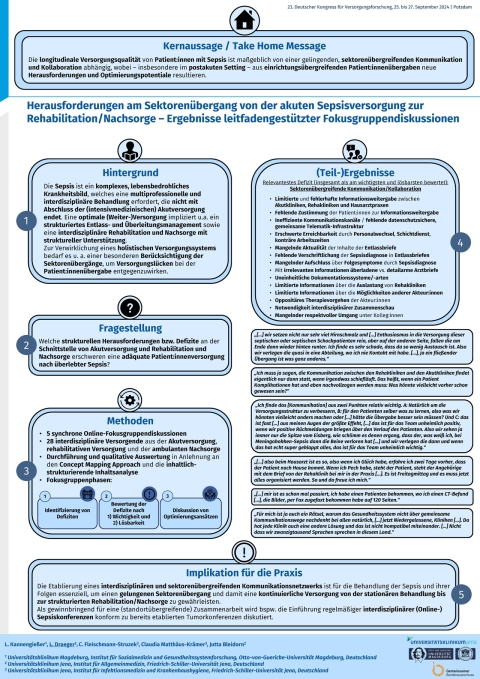
Challenges at the Cross-Sectoral Transition from Acute Sepsis Care to Rehabilitation/Aftercare –Results of Guideline-Based Focus Group Discussions

(DKVF 2024)

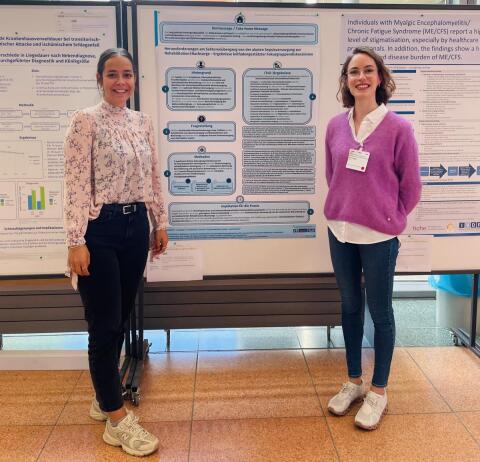
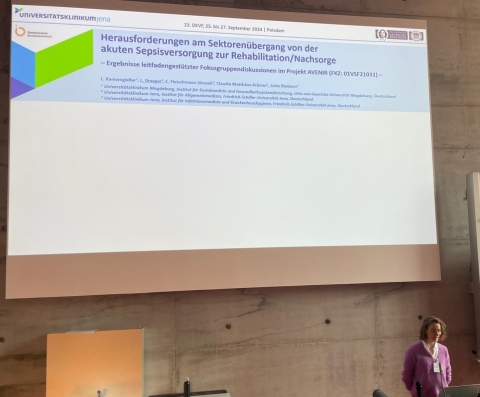
From September 25 to 27, 2024, the 23rd German Congress for Health Services Research took place on the premises of the Potsdam University Campus Griebnitzsee under the motto "Implementation knowledge creates innovative care."Under the category "Results from Health Care Analysis," our research associate Lea Draeger, representing the qualitative AVENIR project team, presented initial findings from an online focus group study in a short presentation and poster session.Together with her project colleague and co-moderator Lena Kannengiesser (Institute of Social Medicine and Health Systems Research, Magdeburg University Hospital), she addressed the following question within the interdisciplinary and cross-sectoral focus group format: Which structural deficits at the interface between acute care and rehabilitation/aftercare hinder adequate patient (follow-up) care after surviving sepsis?The study included neuropsychologists and physicians from specialties such as anesthesiology, intensive care medicine, internal medicine, neurology, physical and rehabilitative medicine, and general practice. To date, little literature exists on the care of sepsis survivors compared to the care of acutely septic patients.One of the numerous findings is that across all focus groups, interdisciplinary and cross-sectoral communication and collaboration among care providers (acute care providers as well as rehabilitation and outpatient aftercare providers) was highlighted as an elementary deficit in the care of sepsis survivors. According to the surveyed experts, this deficit is primarily manifested in limited and/or flawed transfers of (social) medical information and limited exchange or feedback among providers.Identified causes include a lack of data-protection-compliant shared telematics infrastructures and, accordingly, the use of inefficient communication channels (such as fax machines).The establishment of an interdisciplinary and cross-sectoral communication network is therefore described as essential for treating the long-term consequences of sepsis, in order to ensure a successful transition between sectors and thus continuous care from inpatient treatment to structured rehabilitation/aftercare.For instance, the introduction of regular interdisciplinary (online) sepsis conferences, modeled after established tumor boards, is discussed as beneficial for (cross-site) collaboration. The introduction of the electronic patient record is also assessed as very promising for improving the described deficits.A detailed and comprehensive presentation of the results will be available in an upcoming publication.
Homepage Publications
Team
Research areas
Research projects