

Aktuelle Forschungsprojekte
Understanding DC and mononuclear phagocyte functionality in relation to the commensal community and their metabolites
Researcher: Nounagnon Romaric Tochoedo
Supervisor: Prof. Diana Dudziak
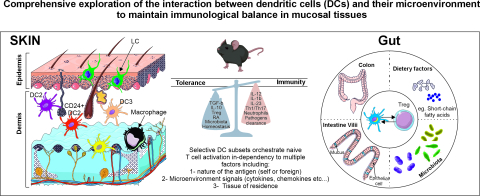
Investigating the phenotype and function of dendritic cells is challenging, particularly in non-lymphoid organs such as the skin and gut. Through their repertoire of antigen recognition, dendritic cells accurately interpret environmental cues to orchestrate appropriate T cell activation in accordance with the local immune state (homeostasis versus pathogenesis). In particular, how dendritic cells integrate both inflammatory signals (e.g. LPS present on the surface of commensal bacteria) and anti-inflammatory signals (commensal bacteria-derived metabolites, such as short-chain fatty acids) to ensure immune tolerance in the gut and skin remains unclear. In our current project, we aim to comprehensively analyze the interaction between dendritic cell subpopulations and their microenvironmental immune stimuli (e.g. commensal bacteria and their metabolites) in the murine gut and skin during homeostasis and disease conditions, using next-generation technologies including FACS, scRNAseq, confocal microscopy, and cell culture platforms.
Our study aims to reveal how the spatial positioning of dendritic cell subpopulations induced by the microbiome in the gut dictates their functions, and how any disturbance in this process could lead to life-threatening conditions such as sepsis. A summary of our current research focus is provided below.
Understanding the Interconnection Between Splenic Dendritic Cell Subsets and Stromal Cells
Researcher: Lizi Trapaidze
Supervisor: Prof. Diana Dudziak
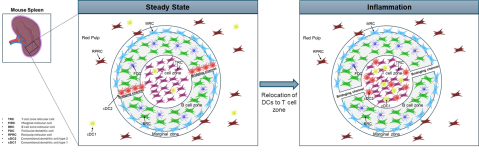
Our research aims to understand how distinct murine dendritic cell (DC) subsets are spatially organized within the spleen during homeostasis versus how they relocate in response to various inflammatory stimuli. We investigate the molecular factors and environmental cues that drive these dynamic changes in DC positioning and function. This leads us to closely examine splenic stromal cells, which form the critical microenvironment orchestrating DC migration and maintenance. While traditionally viewed as structural support, our aim is to highlight the immunological capacity of these stromal cells and how they interact with dendritic cells, to reveal how spatial organization shapes immune activation.
Understanding the dendritic cell sub populations and mononuclear phagocytes in kidney
Researcher: Dr. Damir Vurnek
Supervisor: Prof. Diana Dudziak
Dendritic cells, macrophages, and monocytes are central regulators of tissue homeostasis and immune responses and are present in nearly all tissues in mice and humans. In the kidney, however, the precise identification and classification of these myeloid cell populations has remained challenging, limiting the understanding of their role in renal inflammation and disease. Because tissue-specific environmental cues strongly shape myeloid cell phenotype and function, reliable annotation of renal DCs, macrophages, and monocytes is essential for advancing kidney immunology and improving the interpretation of experimental disease models.
Our research combines high-dimensional phenotyping, functional assays, and in vivo models of inflammation to build a robust framework for the characterization of renal myeloid cell populations in health and disease. By refining the identification of macrophage, monocyte, and dendritic cell subsets without relying on genetically engineered reporter models, we aim to provide broadly applicable tools for preclinical kidney research. This work is intended to support future studies of renal immunity, enable more precise analysis of inflammatory mechanisms, and help reinterpret longstanding concepts in renal myeloid biology.
Interplay between tumor microenvironment and drug therapy in a preclinical model of ovarian cancer by single-cell transcriptomics
Researcher: Dr. Chunguang Liang
Supervisor: Prof. Diana Dudziak
Background
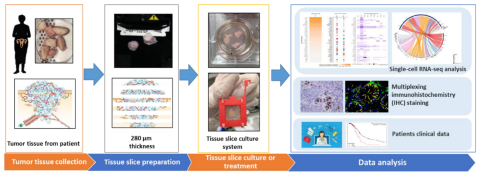
Ovarian cancer is the major cause of death among women with gynecological cancers. It is a complex and heterogeneous disease, usually the patients respond well to the platinum-based first-line chemotherapy, but often the disease becomes increasingly resistant to the treatments. Tumor microenvironment plays a very important role in tumor development and resistance to drug treatment. Our collaboration partner in this project from IKP has developed a preclinical model using precision-cut tumor tissue slices with 200-300 μm thickness to maintain intra-tumor heterogeneity with regard to different cell types and preserved native microenvironment. With their new technology named perfusion air culture (PAC) system, the tissue slices can be cultured with continuous and precisely controlled medium and drug supply (patent: WO/2019/029947). The tumor morphology, viability and heterogeneity in terms of tumor and stromal cells as well as the immune compartment are preserved for up to a week within the system. Our previous bulk RNA-seq data of ovarian tissues slices have showed that it is possible to infer the cell compositions of the tissue slices after drug treatment. However, bulk RNA-seq averages gene expression and fails to identify the respective response of different cell subsets and the drug persistent cell profile. Therefore, using single-cell RNA-seq (scRNA-seq) technology to bridge the cellular characteristics and cellular content with treatment response in the ovarian tumor tissue slices is important to develop efficacious therapies for ovarian cancer.
Aim of the Project
This project will combine the newly tissue slices culture system with the scRNA-seq technology together and benefit from both technologies with their respective advantages. Totally 15 tissue slices samples (in vivo, control, treated groups) from 5 ovarian cancer patients will be used in the project. The focuses of this project are as follows:
• Characterize the tumor microenvironment of ovarian tumor by single-cell transcriptomics. Establish the in silico profiles and a method combining different deconvolution and deep learning approaches to identify the different cell populations including immune cells in the ovarian tumors from different patients.
• Analyze the effects of cisplatin treatment on different cell populations and identify the tolerant and/or resistant subpopulations in the ovarian tumor tissue slices before and after cisplatin treatment. Investigate the cell-cell interactions and their roles in drug persistent effects.
• Validation of the scRNA-seq data with immunohistochemistry (IHC) staining and correlate with the patient clinical data.
• Establish a database and an analyzed platform based on the tissue slices culture and scRNA-seq analysis to predict the drug response of individual patient.
• Multi-omics integration and analysis with scATAC-seq data from 9 different patients
In summary, cultivation of tumor tissue slices provides an ex vivo model that preserves tumor heterogeneity and microenvironment which allows long-term culture of tumor tissue and analysis of therapy response - including immune therapy. Combined with the analysis of scRNA-seq technology, a comprehensive platform can be established as a predictive preclinical model to perform patient-specific ex vivo tests and thus allows personalized therapy.
The atlas of Dendritic cells - Systems immunological understanding of DC
Researcher: Dr. Chunguang Liang
Supervisor: Prof. Diana Dudziak
Dendritic cells (DCs) are a specialized subset of antigen-presenting cells (APCs) that serve a pivotal role in the initiation and regulation of adaptive immune responses. As highly efficient APCs, DCs are often classified as "professional" APCs due to their superior capacity for antigen presentation. The nomenclature of DCs derives from their distinctive morphological features — branched cytoplasmic projections termed dendrites — which emerge during differentiation to maximize surface area and enhance antigen capture.
Despite their widespread distribution across different tissues, the comprehensive characterization of human DC biology remains challenging due to their low abundance in circulation and transient persistence in tissue microenvironments.
To understand the heterogenity of DCs and their multiple roles in different tissue, we aim to construct a high-resolution transcriptomic and proteomic atlas of human and murine DCs respecitively by integrating multi-omics datasets. This initiative will employ systems immunology and bioinformatic approaches to dissect DC heterogeneity across compartments and cell interactions in the microenviroment. Furthermore, we will develop an interactive, user-friendly platform to facilitate data visualization and exploration of molecular interactions within DC populations.
Methods
- Analysing scRNAseq data and bulkRNAseq data
2. Analysising scATAC data
3. CyToF and FACS data analysis
4. R/Python programming, data warehousing and website construction.
5. Machine learning to identify novel marker and function modules.