
Chunguang Liang, Dr. rer. nat.
Group leader of Systems Immunology
Room 207
Institute of Immunology
Leutragraben 3
07743 Jena
Contact
Tel. : +49-3641-9-397503
Fax : +49-3641-9-397502

Description
The research group of Liang is interested in systems immunology and bioinformatics, our lab aims to advance our understanding of interactions between the immune microenvironment and tissue structure, in order for an improvement in human immunotherapies.
Our advantage includes bioinformatic analysis of multi-OMICS data, the integration of machine learning, deep learning and modeling of complicated biological systems. In addition, we are focusing on innovative method, algorithm and software pipeline development.
Research focus
Software and Database
Open positions
we are looking for highly motivated students for master thesis work.
- project 1: Ovarian cancer single cell transcriptome, scATAC, spatial transcriptome (open)
- project 2: Dendritic cell atlas (open)
- project 3: SSc TCR/BCR library (will be open soon)
Researcher: Dr. Chunguang Liang
Supervisor: Prof. Diana Dudziak
Background
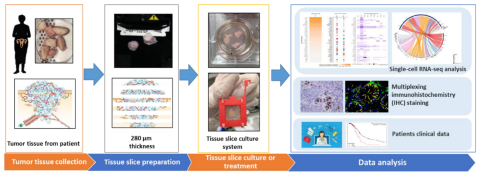
Ovarian cancer is the major cause of death among women with gynecological cancers. It is a complex and heterogeneous disease, usually the patients respond well to the platinum-based first-line chemotherapy, but often the disease becomes increasingly resistant to the treatments. Tumor microenvironment plays a very important role in tumor development and resistance to drug treatment. Our collaboration partner in this project from IKP has developed a preclinical model using precision-cut tumor tissue slices with 200-300 μm thickness to maintain intra-tumor heterogeneity with regard to different cell types and preserved native microenvironment. With their new technology named perfusion air culture (PAC) system, the tissue slices can be cultured with continuous and precisely controlled medium and drug supply (patent: WO/2019/029947). The tumor morphology, viability and heterogeneity in terms of tumor and stromal cells as well as the immune compartment are preserved for up to a week within the system. Our previous bulk RNA-seq data of ovarian tissues slices have showed that it is possible to infer the cell compositions of the tissue slices after drug treatment. However, bulk RNA-seq averages gene expression and fails to identify the respective response of different cell subsets and the drug persistent cell profile. Therefore, using single-cell RNA-seq (scRNA-seq) technology to bridge the cellular characteristics and cellular content with treatment response in the ovarian tumor tissue slices is important to develop efficacious therapies for ovarian cancer.
Aim of the Project
This project will combine the newly tissue slices culture system with the scRNA-seq technology together and benefit from both technologies with their respective advantages. Totally 15 tissue slices samples (in vivo, control, treated groups) from 5 ovarian cancer patients will be used in the project. The focuses of this project are as follows:
• Characterize the tumor microenvironment of ovarian tumor by single-cell transcriptomics. Establish the in silico profiles and a method combining different deconvolution and deep learning approaches to identify the different cell populations including immune cells in the ovarian tumors from different patients.
• Analyze the effects of cisplatin treatment on different cell populations and identify the tolerant and/or resistant subpopulations in the ovarian tumor tissue slices before and after cisplatin treatment. Investigate the cell-cell interactions and their roles in drug persistent effects.
• Validation of the scRNA-seq data with immunohistochemistry (IHC) staining and correlate with the patient clinical data.
• Establish a database and an analyzed platform based on the tissue slices culture and scRNA-seq analysis to predict the drug response of individual patient.
• Multi-omics integration and analysis with scATAC-seq data from 9 different patients
In summary, cultivation of tumor tissue slices provides an ex vivo model that preserves tumor heterogeneity and microenvironment which allows long-term culture of tumor tissue and analysis of therapy response - including immune therapy. Combined with the analysis of scRNA-seq technology, a comprehensive platform can be established as a predictive preclinical model to perform patient-specific ex vivo tests and thus allows personalized therapy.
Researcher: Dr. Chunguang Liang
Supervisor: Prof. Diana Dudziak
Dendritic cells (DCs) are a specialized subset of antigen-presenting cells (APCs) that serve a pivotal role in the initiation and regulation of adaptive immune responses. As highly efficient APCs, DCs are often classified as "professional" APCs due to their superior capacity for antigen presentation. The nomenclature of DCs derives from their distinctive morphological features — branched cytoplasmic projections termed dendrites — which emerge during differentiation to maximize surface area and enhance antigen capture.
Despite their widespread distribution across different tissues, the comprehensive characterization of human DC biology remains challenging due to their low abundance in circulation and transient persistence in tissue microenvironments.
To understand the heterogenity of DCs and their multiple roles in different tissue, we aim to construct a high-resolution transcriptomic and proteomic atlas of human and murine DCs respecitively by integrating multi-omics datasets. This initiative will employ systems immunology and bioinformatic approaches to dissect DC heterogeneity across compartments and cell interactions in the microenviroment. Furthermore, we will develop an interactive, user-friendly platform to facilitate data visualization and exploration of molecular interactions within DC populations.
Methods

Liang C, Spoerl S, Xiao Y, Habenicht KM, Haeusl SS, Sandner I, Winkler J, Strieder N, Eder R, Stanewsky H, Alexiou C, Dudziak D, Rosenwald A, Edinger M, Rehli M, Hoffmann P, Winkler TH, Berberich-Siebelt F. Oligoclonal CD4+CXCR5+ T cells with a cytotoxic phenotype appear in tonsils and blood. Commun Biol. 2024 Jul 18;7(1):879. doi: 10.1038/s42003-024-06563-1. PMID: 39025930; PMCID: PMC11258247.
Böpple K, Oren Y, Henry WS, Dong M, Weller S, Thiel J, Kleih M, Gaißler A, Zipperer D, Kopp HG, Aylon Y, Oren M, Essmann F, Liang C, Aulitzky WE. ATF3 characterizes aggressive drug-tolerant persister cells in HGSOC. Cell Death Dis. 2024 Apr 24;15(4):290. doi: 10.1038/s41419-024-06674-x. PMID: 38658567; PMCID: PMC11043376. (corresponding author)
Heger L, Hatscher L, Liang C, Lehmann CHK, Amon L, Lühr JJ, Kaszubowski T, Nzirorera R, Schaft N, Dörrie J, Irrgang P, Tenbusch M, Kunz M, Socher E, Autenrieth SE, Purbojo A, Sirbu H, Hartmann A, Alexiou C, Cesnjevar R, Dudziak D. XCR1 expression distinguishes human conventional dendritic cell type 1 with full effector functions from their immediate precursors. Proc Natl Acad Sci U S A. 2023 Aug 15;120(33):e2300343120. doi: 10.1073/pnas.2300343120. Epub 2023 Aug 11. PMID: 37566635; PMCID: PMC10438835.
Cao S, Li Y, Song R, Meng X, Fuchs M, Liang C, Kachler K, Meng X, Wen J, Schlötzer-Schrehardt U, Taudte V, Gessner A, Kunz M, Schleicher U, Zaiss MM, Kastbom A, Chen X, Schett G, Bozec A. L-arginine metabolism inhibits arthritis and inflammatory bone loss. Ann Rheum Dis. 2024 Jan 2;83(1):72-87. doi: 10.1136/ard-2022-223626. PMID: 37775153; PMCID: PMC10803985.
Wöhner M, Brechtelsbauer S, Friedrich N, Vorsatz C, Bulang J, Liang C, Schorr L, Beschin A, Guilliams M, Ravetch J, Nimmerjahn F, Biburger M. Tissue niche occupancy determines the contribution of fetal- versus bone-marrow-derived macrophages to IgG effector functions. Cell Rep. 2024 Feb 27;43(2):113757. doi: 10.1016/j.celrep.2024.113757. Epub 2024 Feb 13. PMID: 38354088.
Salihoglu R, Balkenhol J, Dandekar G, Liang C, Dandekar T, Bencurova E. Cat-E: A comprehensive web tool for exploring cancer targeting strategies. Comput Struct Biotechnol J. 2024 Mar 27;23:1376-1386. doi: 10.1016/j.csbj.2024.03.024. PMID: 38596315; PMCID: PMC11001601.
Liang M, Dickel N, Györfi AH, SafakTümerdem B, Li YN, Rigau AR, Liang C, Hong X, Shen L, Matei AE, Trinh-Minh T, Tran-Manh C, Zhou X, Zehender A, Kreuter A, Zou H, Schett G, Kunz M, Distler JHW. Attenuation of fibroblast activation and fibrosis by adropin in systemic sclerosis. Sci Transl Med. 2024 Mar 27;16(740):eadd6570. doi: 10.1126/scitranslmed.add6570. Epub 2024 Mar 27. PMID: 38536934.
Bergmann C, Chenguiti Fakhouri S, Trinh-Minh T, Filla T, Rius Rigau A, Ekici AB, Merlevede B, Hallenberger L, Zhu H, Dees C, Matei AE, Auth J, Györfi AH, Zhou X, Rauber S, Bozec A, Dickel N, Liang C, Kunz M, Schett G, Distler JHW. Mutual Amplification of GLI2/Hedgehog and Transcription Factor JUN/AP-1 Signaling in Fibroblasts in Systemic Sclerosis: Potential Implications for Combined Therapies. Arthritis Rheumatol. 2024 Aug 26. doi: 10.1002/art.42979. PMID: 39187464.
Seeling M, Pöhnl M, Kara S, Horstmann N, Riemer C, Wöhner M, Liang C, Brückner C, Eiring P, Werner A, Biburger M, Altmann L, Schneider M, Amon L, Lehmann CHK, Lee S, Kunz M, Dudziak D, Schett G, Bäuerle T, Lux A, Tuckermann J, Vögtle T, Nieswandt B, Sauer M, Böckmann RA, Nimmerjahn F. Immunoglobulin G-dependent inhibition of inflammatory bone remodeling requires pattern recognition receptor Dectin-1. Immunity. 2023 Mar 14:S1074-7613(23)00093-6. doi: 10.1016/j.immuni.2023.02.019. PMID: 36948194.
Salihoglu R, Srivastave M, Liang C, Schilling K, Szalay A, Bencurova E, Dandekar T. PRO-Simat: Protein network simulation and design tool. Comput Struct Biotechnol J. 2023 Apr 26;21:2767-2779. doi: 10.1016/j.csbj.2023.04.023. PMID: 37181657; PMCID: PMC10172639.
Karl F, Liang C, Böttcher-Loschinski R, Stoll A, Flamann C, Richter S, Lischer C, Völkl S, Jacobs B, Böttcher M, Jitschin R, Bruns H, Fischer T, Holler E, Rösler W, Dandekar T, Mackensen A, Mougiakakos D. Oxidative DNA damage in reconstituting T cells is associated with relapse and inferior survival after allo-SCT. Blood. 2023 Mar 30;141(13):1626-1639. doi: 10.1182/blood.2022017267. PMID: 36564029.
Chen S, Liang C, Li H, Yu W, Prothiwa M, Kopczynski D, Loroch S, Fransen M, Verhelst SHL. Pepstatin-Based Probes for Photoaffinity Labeling of Aspartic Proteases and Application to Target Identification. ACS Chem Biol. 2023 Apr 21;18(4):686-692. doi: 10.1021/acschembio.2c00946. Epub 2023 Mar 15. PMID: 36920024.
Dong M, Böpple K, Thiel J, Winkler B, Liang C, Schueler J, Davies EJ, Barry ST, Metsalu T, Mürdter TE, Sauer G, Ott G, Schwab M, Aulitzky WE. Perfusion Air Culture of Precision-Cut Tumor Slices: An Ex Vivo System to Evaluate Individual Drug Response under Controlled Culture Conditions. Cells. 2023 Mar 4;12(5):807. doi: 10.3390/cells12050807. PMID: 36899943; PMCID: PMC10001200.
Kaltdorf M, Breitenbach T, Karl S, Fuchs M, Kessie DK, Psota E, Prelog M, Sarukhanyan E, Ebert R, Jakob F, Dandekar G, Naseem M, Liang C, Dandekar T. Software JimenaE allows efficient dynamic simulations of Boolean networks, centrality and system state analysis. Sci Rep. 2023 Feb 1;13(1):1855. doi: 10.1038/s41598-022-27098-7. PMID: 36725967; PMCID: PMC9892028. (Corresponding author)
Prada JP, Maag LE, Siegmund L, Bencurova E, Liang C, Koutsilieri E, Dandekar T, Scheller C. Estimation of R0 for the spread of SARS-CoV-2 in Germany from excess mortality. Sci Rep. 2022 Dec 21;12(1):22071. doi: 10.1038/s41598-022-26627-8. Erratum for: Sci Rep. 2022 Oct 14;12(1):17221. PMID: 36543859; PMCID: PMC9768777.
Aydinli M, Liang C, Dandekar T. Motif and conserved module analysis in DNA (promoters, enhancers) and RNA (lncRNA, mRNA) using AlModules. Sci Rep. 2022 Oct 20;12(1):17588. doi: 10.1038/s41598-022-21732-0. PMID: 36266399; PMCID: PMC9584888. (eq. 1St author)
Rohlfing AK, Kolb K, Sigle M, Ziegler M, Bild A, Münzer P, Sudmann J, Dicenta V, Harm T, Manke MC, Geue S, Kremser M, Chatterjee M, Liang C, von Eysmondt H, Dandekar T, Heinzmann D, Günter M, von Ungern-Sternberg S, Büttcher M, Castor T, Mencl S, Langhauser F, Sies K, Ashour D, Beker MC, Lämmerhofer M, Autenrieth SE, Schäffer TE, Laufer S, Szklanna P, Maguire P, Heikenwalder M, Müller KAL, Hermann DM, Kilic E, Stumm R, Ramos G, Kleinschnitz C, Borst O, Langer HF, Rath D, Gawaz M. ACKR3 regulates platelet activation and ischemia-reperfusion tissue injury. Nat Commun. 2022 Apr 5;13(1):1823. doi: 10.1038/s41467-022-29341-1. PMID: 35383158; PMCID: PMC8983782.
Schmidt A, Fuchs M, Stojanović SD, Liang C, Schmidt K, Jung M, Xiao K, Weusthoff J, Just A, Pfanne A, Distler JHW, Dandekar T, Fiedler J, Thum T, Kunz M. Deciphering Pro-angiogenic Transcription Factor Profiles in Hypoxic Human Endothelial Cells by Combined Bioinformatics and in vitro Modeling. Front Cardiovasc Med. 2022 Jun 17;9:877450. doi: 10.3389/fcvm.2022.877450. PMID: 35783871; PMCID: PMC9247153.
Liang C, Rios-Miguel AB, Jarick M, Neurgaonkar P, Girard M, François P, Schrenzel J, Ibrahim ES, Ohlsen K, Dandekar T. Staphylococcus aureus Transcriptome Data and Metabolic Modelling Investigate the Interplay of Ser/Thr Kinase PknB, Its Phosphatase Stp, the glmR/yvcK Regulon and the cdaA Operon for Metabolic Adaptation. Microorganisms. 2021 Oct 14; 9(10):2148. doi: 10.3390/microorganisms 9102148. PMID: 34683468; PMCID: PMC8537086.
Breitenbach T, Rasbach L, Liang C, Jahnke P. A principle feature analysis. Journal of Computational Science. 2022 Feb; 58:101502. https://doi.org/10.1016/j.jocs.2021.101502.
Györfi AH, Matei AE, Fuchs M, Liang C, Rigau AR, Hong X, Zhu H, Luber M, Bergmann C, Dees C, Ludolph I, Horch RE, Distler O, Wang J, Bengsch B, Schett G, Kunz M, Distler JHW. Engrailed 1 coordinates cytoskeletal reorganization to induce myofibroblast differentiation. J Exp Med. 2021 Sep 6;218(9):e20201916. doi: 10.1084/jem.20201916. Epub 2021 Jul 14. PMID: 34259830; PMCID: PMC8288503.
Liang C, Bencurova E, Psota E, Neurgaonkar P, Prelog M, Scheller C, Dandekar T. Population-Predicted MHC Class II Epitope Presentation of SARS-CoV-2 Structural Proteins Correlates to the Case Fatality Rates of COVID-19 in Different Countries. Int J Mol Sci. 2021 Mar 5;22(5):2630. doi: 10.3390/ijms22052630. PMID: 33807854; PMCID: PMC7961590.
Stojanović SD, Fuchs M, Liang C, Schmidt K, Xiao K, Just A, Pfanne A, Pich A, Warnecke G, Braubach P, Petzold C, Jonigk D, Distler JHW, Fiedler J, Thum T, Kunz M. Reconstruction of the miR-506-Quaking axis in Idiopathic Pulmonary Fibrosis using integrative multi-source bioinformatics. Sci Rep. 2021 Jun 14;11(1):12456. doi: 10.1038/s41598-021-89531-7. PMID: 34127686; PMCID: PMC8203802.
Hatscher L, Lehmann CHK, Purbojo A, Onderka C, Liang C, Hartmann A, Cesnjevar R, Bruns H, Gross O, Nimmerjahn F, Ivanović-Burmazović I, Kunz M, Heger L, Dudziak D. Select hyperactivating NLRP3 ligands enhance the TH1- and TH17-inducing potential of human type 2 conventional dendritic cells. Sci Signal. 2021 Apr 27;14(680):eabe1757. doi: 10.1126/scisignal.abe1757. PMID: 33906973.
Whisnant AW, Jürges CS, Hennig T, Wyler E, Prusty B, Rutkowski AJ, L'hernault A, Djakovic L, Göbel M, Döring K, Menegatti J, Antrobus R, Matheson NJ, Künzig FWH, Mastrobuoni G, Bielow C, Kempa S, Liang C, Dandekar T, Zimmer R, Landthaler M, Grässer F, Lehner PJ, Friedel CC, Erhard F, Dölken L. Integrative functional genomics decodes herpes simplex virus 1. Nat Commun. 2020 Apr 27;11(1):2038. doi: 10.1038/s41467-020-15992-5. PMID: 32341360.
Xiao Y, Qureischi M, Dietz L, Vaeth M, Vallabhapurapu SD, Klein-Hessling S, Klein M, Liang C, König A, Serfling E, Mottok A, Bopp T, Rosenwald A, Buttmann M, Berberich I, Beilhack A, Berberich-Siebelt F. Lack of NFATc1 SUMOylation prevents autoimmunity and alloreactivity. J Exp Med. 2021 Jan 4;218(1):e20181853. doi: 10.1084/jem.20181853. PMID: 32986812.
Shahraki A, Yu Y, Gul ZM, Liang C, Iyison NB. Whole genome sequencing of Thaumetopoea pityocampa revealed putative pesticide targets. Genomics. 2020 Jul 8:S0888-7543(20)30038-0. doi: 10.1016/j.ygeno.2020.07.017. Epub ahead of print. PMID: 32652101.
Breitenbach T, Liang C, Beyersdorf N, Dandekar T. Analyzing pharmacological intervention points: A method to calculate external stimuli to switch between steady states in regulatory networks. PLoS Comput Biol. 2019 Jul 16;15(7):e1007075. doi: 10.1371/journal.pcbi.1007075. (eq. 1St author)
Kunz M, Liang C, Nilla S, Cecil A, Dandekar T. The drug-minded protein interaction database (DrumPID) for efficient target analysis and drug development. Database (Oxford). 2016 Apr 7;2016. pii: baw041. (eq. 1St author)
Kaltdorf M, Srivastava M, Gupta SK, Liang C, Binder J, Dietl AM, Meir Z, Haas H, Osherov N, Krappmann S, Dandekar T. Systematic Identification of Anti-Fungal Drug Targets by a Metabolic Network Approach. Front Mol Biosci. 2016 Jun 17;3:22. doi: 10.3389/fmolb.2016.00022. PMID: 27379244; PMCID: PMC4911368. (eq. 1St author)
Ampattu BJ, Hagmann L, Liang C, Dittrich M, Schlüter A, Blom J, Krol E, Goesmann A, Becker A, Dandekar T, Müller T, Schoen C. Transcriptomic buffering of cryptic genetic variation contributes to meningococcal virulence. BMC Genomics. 2017 Apr 7;18(1):282.
Liang C, Schaack D, Srivastava M, Gupta SK, Sarukhanyan E, Giese A, Pagels M, Romanov N, Pané-Farré J, Fuchs S, Dandekar T. A Staphylococcus aureus Proteome Overview: Shared and Specific Proteins and Protein Complexes from Representative Strains of All Three Clades. Proteomes. 2016 Feb 19;4(1):8. doi: 10.3390/proteomes4010008. PMID: 28248218; PMCID: PMC5217359.
Gabed N, Yang M, Bey Baba Hamed M, Drici H, Gross R, Dandekar T, Liang C*. Draft Genome Sequence of the Moderately Heat-Tolerant Lactococcus lactis subsp. lactis bv. diacetylactis Strain GL2 from Algerian Dromedary Milk. Genome Announc. 2015 Nov 19;3(6). pii: e01334-15. (Corresponding & Last author)
Cecil A, Ohlsen K, Menzel T, François P, Schrenzel J, Fischer A, Dörries K, Selle M, Lalk M, Hantzschmann J, Dittrich M, Liang C, Bernhardt J, Ölschläger TA, Bringmann G, Bruhn H, Unger M, Ponte-Sucre A, Lehmann L, Dandekar T. Modelling antibiotic and cytotoxic isoquinoline effects in Staphylococcus aureus, Staphylococcus epidermidis and mammalian cells. Int J Med Microbiol. 2015 Jan;305(1):96-109.
Kunz M, Xiao K, Liang C, Viereck J, Pachel C, Frantz S, Thum T, Dandekar T. Bioinformatics of cardiovascular miRNA biology. J Mol Cell Cardiol. 2015 Dec;89(Pt A):3-10.
Reister M, Hoffmeier K, Krezdorn N, Rotter B, Liang C, Rund S, Dandekar T, Sonnenborn U, Oelschlaeger TA. Complete genome sequence of the gram-negative probiotic Escherichia coli strain Nissle 1917. J Biotechnol. 2014 Oct 10;187:106-7.
Winstel V, Liang C, Sanchez-Carballo P, Steglich M, Munar M, Bröker BM, Penadés JR, Nübel U, Holst O, Dandekar T, Peschel A, Xia G. Wall teichoic acid structure governs horizontal gene transfer between major bacterial pathogens. Nat Commun. 2013;4:2345.
Liang C, Krüger B, Dandekar T. GoSynthetic database tool to analyse natural and engineered molecular processes. Database (Oxford). 2013 Jun 27;2013:bat043.
Ratzka C, Förster F, Liang C, Kupper M, Dandekar T, Feldhaar H, Gross R. Molecular characterization of antimicrobial peptide genes of the carpenter ant Camponotus floridanus. PLoS One. 2012;7(8):e43036.
Förster F, Beisser D, Grohme MA, Liang C, Mali B, Siegl AM, Engelmann JC, Shkumatov AV, Schokraie E, Müller T, Schnölzer M, Schill RO, Frohme M, Dandekar T. Transcriptome analysis in tardigrade species reveals specific molecular pathways for stress adaptations. Bioinform Biol Insights. 2012;6:69-96.
Krüger B, Liang C, Prell F, Fieselmann A, Moya A, Schuster S, Völker U, Dandekar T. Metabolic adaptation and protein complexes in prokaryotes. Metabolites. 2012 Nov 16;2(4):940-58.
Liang C, Liebeke M, Schwarz R, Zühlke D, Fuchs S, Menschner L, Engelmann S, Wolz C, Jaglitz S, Bernhardt J, Hecker M, Lalk M, Dandekar T. Staphylococcus aureus physiological growth limitations: insights from flux calculations built on proteomics and external metabolite data. Proteomics. 2011 May;11(10):1915-35.
Ratzka C, Liang C, Dandekar T, Gross R, Feldhaar H. Immune response of the ant Camponotus floridanus against pathogens and its obligate mutualistic endosymbiont. Insect Biochem Mol Biol. 2011 Aug;41(8):529-36.
Cecil A, Rikanović C, Ohlsen K, Liang C, Bernhardt J, Oelschlaeger TA, Gulder T, Bringmann G, Holzgrabe U, Unger M, Dandekar T. Modeling antibiotic and cytotoxic effects of the dimeric isoquinoline IQ-143 on metabolism and its regulation in Staphylococcus aureus, Staphylococcus epidermidis and human cells. Genome Biol. 2011;12(3):R24.
Siegl A, Kamke J, Hochmuth T, Piel J, Richter M, Liang C, Dandekar T, Hentschel U. Single-cell genomics reveals the lifestyle of Poribacteria, a candidate phylum symbiotically associated with marine sponges. ISME J. 2011 Jan;5(1):61-70.
Schauer K, Geginat G, Liang C, Goebel W, Dandekar T, Fuchs TM. Deciphering the intracellular metabolism of Listeria monocytogenes by mutant screening and modelling. BMC Genomics. 2010 Oct 18;11:573.
Liang C, Schmid A, López-Sánchez MJ, Moya A, Gross R, Bernhardt J, Dandekar T. JANE: efficient mapping of prokaryotic ESTs and variable length sequence reads on related template genomes. BMC Bioinformatics. 2009 Nov 29;10:391.
Förster F, Liang C, Shkumatov A, Beisser D, Engelmann JC, Schnölzer M, Frohme M, Müller T, Schill RO, Dandekar T. Tardigrade workbench: comparing stress-related proteins, sequence-similar and functional protein clusters as well as RNA elements in tardigrades. BMC Genomics. 2009 Oct 12;10:469.(eq. 1St author)
Zhang Q, Liang C, Yu YA, Chen N, Dandekar T, Szalay AA. The highly attenuated oncolytic recombinant vaccinia virus GLV-1h68: comparative genomic features and the contribution of F14.5L inactivation. Mol Genet Genomics. 2009 Oct;282(4):417-35. (eq. 1St author)
Liang C, Wolz C, Herbert S, Bernhard J, Engelmann S, Hecker M, Götz F, Dandekar T., GENOVA: A rapid genome visualization and functional genomics software applied to strain comparisons in Staphylococcus aureus. 2009, 10(2):201-217.
Schwarz R, Liang C, Kaleta C, Kühnel M, Hoffmann E, Kuznetsov S, Hecker M, Griffiths G, Schuster S, Dandekar T. Integrated network reconstruction, visualization and analysis using YANAsquare. BMC Bioinformatics. 2007 Aug 28;8:313. (eq. 1St author)
Liang C*, Dandekar T. inGeno - an integrated genome and ortholog viewer for improved genome to genome comparisons. BMC Bioinformatics. 2006 Oct 20;7:461. (Corresponding author, 1st author)
Hain T, Steinweg C, Kuenne CT, Billion A, Ghai R, Chatterjee SS, Domann E, Kärst U, Goesmann A, Bekel T, Bartels D, Kaiser O, Meyer F, Pühler A, Weisshaar B, Wehland J, Liang C, Dandekar T, Lampidis R, Kreft J, Goebel W, Chakraborty T. Whole-genome sequence of Listeria welshimeri reveals common steps in genome reduction with Listeria innocua as compared to Listeria monocytogenes. J Bacteriol. 2006 Nov;188(21):7405-15.