

Advanced Medical Scientist-Programm
Das Advanced Medical Scientist-Programms (AMSP) fördert die Karriere von forschungserfahrenen nicht-ärztlichen Wissenschaftlerinnen und Wissenschaftlern in der Medizin (Advanced Medical Scientists), die translationale, patienten- oder grundlagenorientierte Forschungsprojekte verantwortlich betreuen und ihre Habilitation erlangen möchten. Ziel ist es, die Bearbeitung längerfristig angelegter Forschungsprojekte zu unterstützen und damit hochrangige Publikationen und die Einwerbung neuer Drittmittelprojekte zu fördern. Das AMSP ist Teil der kontinuierlichen Nachwuchsförderstruktur für Medical Scientists an der Medizinischen Fakultät Jena.
Im Rahmen des dreijährigen AMSP werden folgende Weiterbildungselemente angeboten: ein begleitendes strukturiertes Qualifizierungsprogramm zur Vermittlung methodischer und wissenschaftlicher Kompetenzen, ein Karriere- und Mentoringprogramm zur Unterstützung der persönlichen Karriereentwicklung und die Einbindung der Geförderten in Lehr- und Betreuungsaufgaben für den wissenschaftlichen Nachwuchs. Alle im Projekt geförderten Doktoranden nehmen verpflichtend an einem der strukturierten Graduiertenprogramme der Jena School of Molecular Medicine (JSMM) teil.
Eine aktuelle Ausschreibung ist momentan nicht verfügbar. Die nächste Ausschreibungsrunde wird voraussichtlich im Spätherbst 2026 veröffentlicht.
Informationen zu den Bewerbungsunterlagen finden Sie weiter unten.
AMSP IZKF - Kollegiatinnen und Kollegiaten
Neue Förderungen aus 2026
AMSP 23 - Dr. Feliberto de la Cruz

Advanced Medical Scientist-Programm 2026
Thema: "Nucleus Tractus Solitarii: The Central Player for Brain–Heart Dysregulation in Anorexia Nervosa"
Zusammenfassung:
Autonomic imbalance represents a hallmark feature of anorexia nervosa (AN) and manifests clinically as bradycardia (low heart rate) and exaggerated parasympathetic output, which together increase cardiovascular risk. The neural mechanisms driving this dysregulation remain poorly understood. Recent findings from our group investigating brain–heart communication consistently point to a small brainstem region, the nucleus tractus solitarii (NTS), as a central contributor to this imbalance. The NTS serves as the main gateway through which sensory signals from the body influence higher autonomic and emotional control centers, while also coordinating descending command signals that regulate cardiovascular activity. Building on our previous works on dynamic brain connectivity and white-matter organization in AN, this project focuses on the NTS as a potential central node contributing to autonomic imbalance. Using advanced MRI techniques combined with physiological recordings, we will assess NTS structure, connectivity with higher brain regions, and its coupling with cardiac activity across different stages of the disorder. By understanding how altered NTS function disrupts 1 brain–heart communication, this study aims to elucidate the neural mechanisms underlying autonomic imbalance in AN.
Aktive Förderungen aus 2025
AMSP 21 - Dr. Julia Greiser
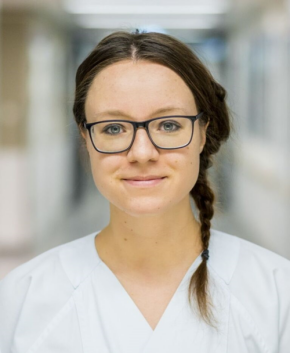
Advanced Medical Scientist-Programm 2025
Thema: "Entwicklung theranostischer Radiopharmaka für die Behandlung von Hepatozellulärem Karzinom"
Zusammenfassung:
Im Rahmen der AMSP-Förderung des IZKF sollen potenzielle Radio-Theranostika (d.h. Radiopharmaka für Diagnostik und Therapie) für die Behandlung des Hepatozellulären Karzinoms (HCC) entwickelt werden. Diese würden ein patienten-individuelles, nicht-invasives Staging der Erkrankung und die Beurteilung der Leberfunktion sowie der Therapierbarkeit des Tumors mit der einer internen Bestrahlung des HCCs mit tumoriziden Beta-Minus-Teilchen (Radionuklidtherapie) kombinierbar machen. Hierfür sollen HCC-spezifische Farbstoff-basierte Radiopharmaka durch „Markierung“ mit radioaktiven Iod-Isotopen entwickelt werden, mit dem Fluoreszenzfarbstoff Indocyaningrün (ICG) als Leitstruktur, da dieser in vielen HCCs gespeichert wird. Die hepatobiliäre Clearance und die HCC-Speichercharakteristik der Radiopharmaka wird präklinisch anhand eines HCC-Xenograft-Modells unter Verwendung bebrüteter Vogeleier als Tierversuchsersatzmodell
durchgeführt. Am Ende des Projektes soll die Translation des best perfoming Theranostikums an einem ersten klinischen Einzelfall erreicht sein. Die AMSP-Förderung soll zur Finanzierung einer Doktorandin sowie zur Deckung von Sachkosten verwendet werden und dabei die Durchführung des Vorhabens, die Habilitation der Antragstellerin sowie den Aufbau einer unabhängigen Nachwuchsforschergruppe unter Leitung der Antragstellerin ermöglichen.
AMSP 22 - Dr. Nico Andreas

Advanced Medical Scientist-Programm 2025
Thema: "Characteristic macrophages in glioblastomas"
Zusammenfassung:
Glioblastomas (GBM) are one of the most aggressive primary brain tumors in adults. Despite various strategies including differential single cell gene expression analyses between GBM and healthy tissues, none of the resulting findings could benefit the development of promising therapies, yet. Various macrophage populations coevolve in the tumor microenvironment of GBMs and not only support a tumor immune evasion but also tumor spreading throughout the surrounding tissue, ultimately resulting an incomplete resectability with very high recidive frequencies. We could identify a Siglec10+CX3CR1+ macrophage population, which was specific to GBMs when compared to other very frequent tumor entities like meningiomas (MNGs), non-GBM gliomas and metastases (MTS).
In our project, we will characterize this potentially pro-tumorigenic Siglec10+CX3CR1+ macrophage population on transcriptome level, test its capacity to modulate tumor and immune cells in their microenvironment, describe their generation in presence of GBM tumor cells and analyze metabolic alterations in their local, residential microenvironment. Our goal is to distillate unique markers or interaction mechanisms as targets for new promising therapies. Modulation of these macrophages could stop the diffuse growth of GBMs and potentially would result in a total resectability of GBMs without recurrence.
Aktive Förderungen aus 2024
AMSP 20 - Dr. Julia Drube

Advanced Medical Scientist Programm 2024
Thema: ETAR in ovarian carcinoma: Modulation of signaling activity by kinases and phosphatases
Zusammenfassung:
The G protein coupled receptor (GPCR) endothelin receptor type A (ETAR) was found to be an important player in many different cancer types, among them ovarian carcinoma. Specific GPCR kinases (GRKs) phosphorylate the receptor and initiate its
desensitization via β-arrestins. One of the GRKs, GRK5 was reported to be significantly downregulated in ovarian cancer patient samples. In initial studies, we identified GRK5 as the most important GRK in regulating β-arrestin recruitment and ETAR trafficking. Therefore, we will investigate the influence of GRK5 on the ETAR signaling and the malignancy of ovarian carcinoma. The dephosphorylation by phosphatases (PPs) is in general understudied in the GPCR field, despite its crucial
role in resensitization of the receptor. We plan to identify the phosphatases acting on the ETAR and will create KO cell lines to further study their part in mediating the malignant potential of the ovarian carcinoma cell line A2780. The molecular insights
that will be gained in this project will open the possibility to identify novel treatment strategies for this hard to treat cancer type.
Aktive Förderungen aus 2023
AMSP 18 - Dr. Judit Symmank

Advanced Medical Scientist-Programm 2023
Thema: "The neurotrophic cytokine GDF15 - a potential epigenetic target for modulating orthodontic pain?"
Zusammenfassung:
During orthodontic therapy, 94 % of patients experiencing considerable pain with peaks around 24 hours after each treatment procedure. This should be considered critically, since it significantly affects the patient motivation and commitment to undergo and continue orthodontic therapy. Pharmacological treatment of orthodontic pain commonly targets the inflammatory component of nociceptor nerve activation. Unfortunately, this appears to be detrimental to tooth movement by impacting tissue and bone remodeling. These processes are triggered by a local aseptic inflammation modulated by periodontal ligament fibroblasts. We recently reported that GDF15, a TGF-β superfamily member, contributes to their mechanoresponse and in general agreement with other studies, our preliminary results also suggest a neurotropic role in the orthodontic context. Being discussed as potential intervention target in a variety of medical conditions, epigenetically adapting GDF15 levels by modulating histone modifications are considered as promising approach. However, with regard to orthodontics, the role of GDF15 in pain perception has not yet been addressed. Therefore, this study aims to investigate the neurotropic properties and underlying mechanisms of GDF15 in the context of orthodontic pain perception in vitro and in vivo, further focusing on the role of epigenetic regulation and a potential therapeutic inhibitor application.
Bewerbung
Voraussetzung
Voraussetzung. Sie können einen Antrag auf Förderung stellen, wenn
- Sie wissenschaftlicher Mitarbeiter/wissenschaftliche Mitarbeiterin der Medizinischen Fakultät der FSU Jena sind,
- Ihre Promotion nicht länger als 9 Jahre zurückliegt (Elternzeiten, die in diesen Zeitraum fallen, werden angerechnet (pro Kind 2 Jahre)) und Sie noch nicht habilitiert sind,
- Sie einen Gesamt-Impaktfaktor > 40 erreicht haben und dabei mindestens eine Originalpublikation mit Impaktfaktor > 6 als Erst- oder Letztautor vorweisen können (bei Publikationen als Erst- oder Letztautor in für das jeweilige Fachgebiet herausragenden Journalen
kann in Absprache mit dem IZKF-Vorstand der notwendige Gesamt-Impaktfaktor niedriger sein), - Sie eine Habilitation in einem klinischen oder experimentellen Fach beabsichtigen und dies durch entsprechende Vorarbeiten belegen können,
- eine Stellungnahme der verantwortlichen Instituts- oder Klinikleitung vorliegt, dass Ihre Stelle für den beantragten Förderzeitraum gesichert ist.
Förderung
Das Programm hat eine Laufzeit von drei Jahren mit einer Zwischenbegutachtung nach 2 Jahren. Der Förderumfang beträgt bis zu 50.000 € pro Projekt und Jahr für Sach- und Personalmittel, wobei auch bis zu 50 % der eigenen Stelle finanziert werden kann. Der aktuell-vorgesehene Förderzeitraum ist der 01.09.2026 bis 31.08.2029 (nach positiver Zwischenevaluation).
Zum Zeitpunkt der Zwischenbegutachtung soll ein Antrag für die Einwerbung eines Drittmittelprojektes (DFG-Antrag auf Sachbeihilfe oder vergleichbare öffentliche Förderung) vorliegen, der in die Begutachtung eingeht.
Downloads
Folgende Dokumente stehen für die Antragserstellung für Sie zum Downloaden zur Verfügung:
- Ausschreibung
- AMSP-Vorlage Bewerbungsunterlagen
- AMSP_Formblatt Stellungnahme Einrichtungsleitung
- AMSP_Formblatt Bestätigung wissenschaftler Einrichtung
- AMSP_Formblatt Bereitschaftserklärung Antragstellende