


Welcome to the internet presence of my most important projects.
Arbeitsgruppen
Am Institut für Medizinische Mikrobiologie werden verschiedene Forschungsprojekte bearbeitet, die sich folgenden Schwerpunkten zuordnen lassen:
- Grundlagenforschung zur bakteriellen Pathogenese
- Klinisch angewandte Forschung zur Diagnose von Infektionskrankheiten
Informationen zu den verschiedenen Forschungsprojekten finden Sie unter den aufgeführten Arbeitsgruppen.
AG Löffler
Projects
From acute to chronic and difficult-to-treat infections caused by S. aureus
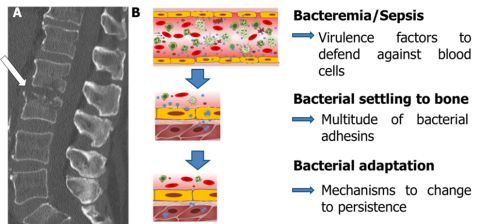
Chronic and difficult-to-treat infections are a major research focus of our institute. We have long-standing experience with S. aureus infections that can develop from an acute destructive infection into a chronic infection that can be extremely difficult to treat. The reason for this can be that the pathogens (i) invade host cells and hide intracellularly, (ii) chance their phenotypes to small-colony-variants (SCVs) that have a low metabolism and can escape from the immune system and from antibiotics, and (iii) form biofilm. Important examples for chronic S. aureus infections are osteomyelitis and endocarditis. In several project we investigate the patho-mechanisms of the infections. For this, we have developed in-vitro cell culture and in-vivo murine models that can be analysed from the acute to the chronic stage. We investigate the bacterial adaptation strategies and the host response.
Currently, we have funding from the BMBF-consortium “Mesinflame”.
Project management: Bettina Löffler, in cooperation with Ute Neugebauer (CSCC)
Funding: Project funding by the CSCC (Center for Sepsis Control and Care; BMBF)



The lung microbiome and their influence on infection development
Since many years we analyse lung infections caused by S. aureus, by influenza virus or by both pathogens (co-infections). We study different virulence factors that cause lung inflammation and destruction, such as the S. aureus pore-forming toxins. In the co-infection, both pathogens interact, which can aggravate pneumonia. In a recent project we study the lung microbiome and its impact on infection development. We analyse the microbiome in surgical samples in different locations of the lung by culture methods, by sequencing and by imaging techniques. Additionally, we established complex cell culture models, including the alveolar-on-a-chip model that mimics the situation in the lung. We aim to colonize our cell culture models with bacteria belonging to the microbiome and infect the system with pathogens. Thereby the role of the microbiota and possible therapeutic interventions will be studied.
Currently, we have funding from DFG by the Excellence Cluster “Balance of the Microverse” and the SFB 1278 “PolyTarget”
Project management: Bettina Löffler, in cooperation with Hortense Slevogt (Septomics)
Funding: BMBF im Rahmen des InfectoGnostics Forschungscampus

Diagnostic and translational research
To improve our diagnostic work we continuously aim to develop new methods. We have collaborations with the Leibniz Institute of Photonic Technology and use imaging methods to detect pathogens in diagnostic samples. In particular, we work on fast blood culture detection methods that can directly identify the pathogens in blood samples from patients with short (or no) cultivation steps. Furthermore, we work on rapid antimicrobial resistance testings that are based on early microbial changes that can be detected by imaging methods.
In general, we check newly developed techniques for their application in routine diagnostics, ranging from blood culture detection analytic methods to multiplex PCR systems designed for POCT-diagnostics.
Currently, we have funding by the BMBF by the InfectoGnostics Campus Jena, project “InfectoExplore” and “ADA” and by the BMBF-funding for the “Leibniz-Zentrum für Photonik in der Infektionsforschung”.
Project management: Bettina Löffler
CV
Academic education and degrees
2012 |
Board certificate for “Microbiology and Epidemiology in Infection” |
2011 |
Habilitation, “Staphylococcus aureus Infektionen an zellulären Barrieren: Inflammation, Zellzerstörung, Defektheilung und bakterielle Langzeit-Persistenz”, University Hospital of Münster (UKM) |
2000 |
Dr. med., Thesis: “Der Einfluß von Glucose und Hyperosmolarität auf peritoneale Mesothelzellen”, University of Munich (LMU) |
1999 |
State examination Medicine |
1992–1999 |
Studies of Medicine, University of Munich (LMU) [and University of Birmingham and Cincinnati] |
Stages of scientific work
since 2014 |
Professor for Medical Microbiology (W3), University of Jena (UKJ)
|
2014 |
Call for the W3 Professorship of the Institute of Medical Microbiology, University Hospital of Münster (declined) |
2002–2014 |
Resident Physician, Clinical training in Medical Microbiology; setup and management of the research group “Cellular Microbiology” in the Institute of Medical Microbiology at the University Hospital Münster |
2000–2002 |
Research fellowship from the DFG at the Gaubius Laboratory, The Netherlands Organisation for Applied Scientific Research (TNO), Leiden, The Netherlands |
1999–2000 |
Internship at the Medical Clinics, Nephrology/Immunology, LMU Munich |
Awards and functions
since 2021 |
Elected member of the “DFG-Fachkollegium 204: Mikrobiologie, Virologie und Immunologie” |
| 2019 | Thüringer Forschungspreis 2019 in der Kategorie Angewandte Forschung |
| since 2019 | Member and PI of the DFG-Excellence Cluster “Balance of the Microverse” |
| since 2018 | Member of the “Stiftung der Deutschen Gesellschaft für Hygiene und Mikrobiologie” |
| since 2018 | Managing board of the IZKF, Jena |
| since 2017 | Head of the Board, Center of Innovation Competence (CIC) Septomics |
| since 2015 | Member of the Jena Center for Microbial Communication (JCMC) |
| 2015–2021 | Deputy spokesperson, Center for Sepsis Control and Care (CSCC), Jena |
| since 2014 | Managing board of the Centre of Innovation Competence (ZIK) Septomics |
| since 2014 | Consulting activities and PI in InfectoGnostics, Jena |
| 2011–2013 | Organization of the annual ‘Immunology-Meeting’, Münster |
| 2009–2014 | Project leaderships and organization work in CRCs und BMBF-funded research consortia in Münster (e.g. CRC 492/B9; CRC/TR 34/C12, C14; CRC 1009/B1; CRC 656/A10) |
| 2003–2006 | Research grants from the Else-Kröner Fresenius Stiftung |
| 2000–2002 | Research fellowship from the DFG at the Gaubius Laboratory, The Netherlands Organisation for Applied Scientific Research (TNO), Leiden, The Netherlands |
| since 2010 | Reviewer for the DFG and DZIF; Austrian, French and Polish research projects |
since 2005 |
Reviewer for about 25 international leading peer reviewed scientific journals |
Publications
Pubmed: Haslinger B Sitter T, Haslinger B Kooistra T, Haslinger-Löffler B, Löffler B Peters G or Löffler B Jena
https://pubmed.ncbi.nlm.nih.gov/?term=Haslinger+B+Sitter+T
https://pubmed.ncbi.nlm.nih.gov/?term=Haslinger+B+Kooistra+T
https://pubmed.ncbi.nlm.nih.gov/?term=Haslinger-L%C3%B6ffler+B
https://pubmed.ncbi.nlm.nih.gov/?term=L%C3%B6ffler+B+Peters+G
AG Rödel
Projects
Development and evaluation of rapid molecular diagnostic assays
The focus of our research is the conception and evaluation of molecular assays based on loop-mediated isothermal amplification (LAMP) for the use as rapid diagnostic tests in routine laboratories. LAMP offers the potential to test sample without nucleic acid extraction in a very short turnaround time of ≤ 30 min.
Projects:
- Rapid blood culture testing for identification of bacterial and fungal species and resistance marker genes
- Identification of beta-lactamase genes in Enterobacterales isolates (ESBL, AmpC, and carbapenemases)
- Differentiation of virulence factors of intestinal pathogenic E. coli, e. g. EHEC, in stool samples and culture isolates
- Rapid Salmonella typing
- Culture-independent diagnostics of deep tissue infections and endocarditis
- Rapid diagnostic tests for respiratory viruses (Influenza virus, SARS-CoV-2)
Industrial partner for scientific cooperation: Amplex Diagnostics GmbH (Gars-Bahnhof, Germany)

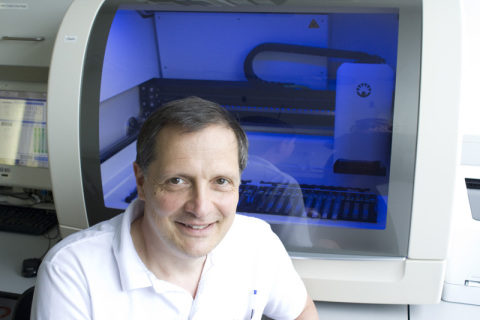
Automation in microbiology
We work on the development of automatized workflows in culture-dependent microbiological diagnostics and the integration of automated PCR systems. Automated culture microbiology and PCR in the bacteriology laboratory was implemented by installation of the BD Kiestra Work Cell Automation (WCA) and BD MAX PCR systems. The aims of this work are:
- To decrease the time of diagnostic reports including results of antimicrobial susceptibility testing
- To increase the sensitivity and quality of culture microbiology by high-resolution streaking of cultures and improved conditions of culture incubation
- To improve the surveillance of multi-resistant pathogens
Industrial partner for scientific cooperation: Becton Dickinson GmbH (Heidelberg, Germany)

CV
Professional activities
| 2017 | apl. Professor (extraordinary Professor) of Medical Microbiology |
| 2016 | Medizinischer Fachmikrobiologe (DGHM/BÄMI, specialist in medical microbiology and infectious disease epidemiology) |
since 2012 |
Head of the laboratory for bacteriological and mycological diagnostics |
| 2010 | Akademischer Oberrat |
| 2007 | Habilitation (post doc thesis), Jena University Hospital, Friedrich Schiller University of Jena, Topic: Modulation of the host cell response by Chlamydia infection |
| 1997–2007 | Post doc, Institute of Medical Microbiology, Jena University Hospital |
Education
| 1993–1997 | Dr. rer. nat (PhD) in Microbiology, Friedrich Schiller University of Jena |
| 1988–1993 | Diploma in Biology with emphasis on Microbiology, Zoology, and Biochemistry, Friedrich Schiller University of Jena |
Teaching activities
Lectures and practical training in Medical Microbiology for students of:
- M.Sc. Molecular Medicine
- Human medicine
- Dental medicine
- M.Sc. Chemical Biology
- B.Sc. Nutritional Science
- B.Sc. Biochemistry and Molecular Biology
Publications
Pubmed: Rödel J Jena