

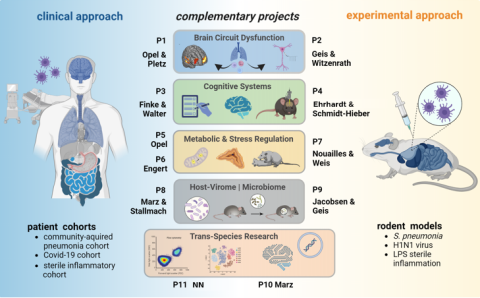
Die Forschungsprojekte von NeurInfect sind translational und interdisziplinär aufgebaut. In eng verzahnten experimentellen und klinischen Teilprojekten untersuchen wir, wie respiratorische Infektionen neuronale Netzwerke, Immunantworten und die Gehirn-Körper-Kommunikation beeinflussen. Harmonisiert genutzte Patientenkohorten, etablierte Tiermodelle und eine gemeinsam genutzte methodische Infrastruktur ermöglichen projektübergreifende Vergleiche und eine exzellente Ausbildung der Promovierenden.
Klinische Projekte
|
P1: Nils Opel, Mathias Pletz: |
Unraveling the dynamic relationship between systemic inflammation and brain network dysfunction during acute pneumonia and recovery |
| P3: Kathrin Finke, Martin Walter: | Early detection of neurocognitive changes in patients with pneumonia |
|
P5: Nils Opel: |
Metabolic dysregulation as a moderator of neuropsychiatric sequelae following respiratory infection |
|
P6: Veronika Engert: |
The role of stress and social abilities in the trajectory from respiratory infection to neuropsychiatric impairment |
|
P8: Manja Marz, Andreas Stallmach: |
Trajectories of host virome/microbiome interaction with neuropsychiatric sequelae following respiratory infection |
Kohortenstudie
Im Rahmen der klinischen Projekte von NeurInfect untersuchen wir, warum manche Menschen nach einer Infektion langfristig unter Müdigkeit, Konzentrationsproblemen oder Veränderungen der Stimmung leiden, während andere keine solchen Beschwerden entwickeln. Dabei betrachten wir unter anderem das Zusammenspiel von Immunsystem und Gehirn sowie mögliche Einflüsse von Stoffwechsel, Stress, sozialen Faktoren und Mikrobiom. Ein besonderer Fokus liegt auf Veränderungen während einer akuten Infektion und der anschließenden Erholungsphase. Hierzu werden Patienten mit einer akuten Atemwegsinfektion über den Krankheitsverlauf hinweg untersucht. Ergänzend nehmen gesunde Kontrollpersonen an der Studie teil, um Veränderungen besser einordnen zu können. Mit verschiedenen Untersuchungen, unter anderem zu kognitiven Funktionen, Stoffwechsel, Immunreaktionen und Gehirnfunktion, möchten wir die Entstehung postinfektiöser Beschwerden besser verstehen. Die Ergebnisse sollen dazu beitragen, Risikofaktoren frühzeitig zu erkennen und langfristig neue Ansätze für Prävention und Therapie zu entwickeln.
|
P2: Christian Geis, Martin Witzenrath: |
Impact of pneumonia and mechanical ventilation on immune-neuronal interaction and hippocampal circuit dysfunction | |
|
P4: Christina Ehrhardt, Christoph Schmidt-Hieber: |
Inflammation modulates hippocampal memory processing following viral respiratory infection | |
|
P7: Geraldine Nouailles, Sebastian Weis: |
Exploring the role of stress, metabolism, and age on long-term cognitive impairment following pneumococcal pneumonia | |
|
P9: Ilse Jacobsen, Christian Geis: |
Effects of the gut microbiome modification on infection and inflammation-induced cognitive dysfunction |
|
P10: Manja Marz: |
Role of small extracellular vesicles in humoral body-brain communication in respiratory infection |
|
P11: |
Relevance of the memory T cell repertoire for the development of neuropsychiatric sequelae after respiratory infection |