
Der Einsatz von Point-of-Care Tests in der ambulanten vertragsärztlichen Versorgung ist rückläufig
24. Deutschen Kongress für Versorgungsforschung (DKVF) am 22.-24.09.2024

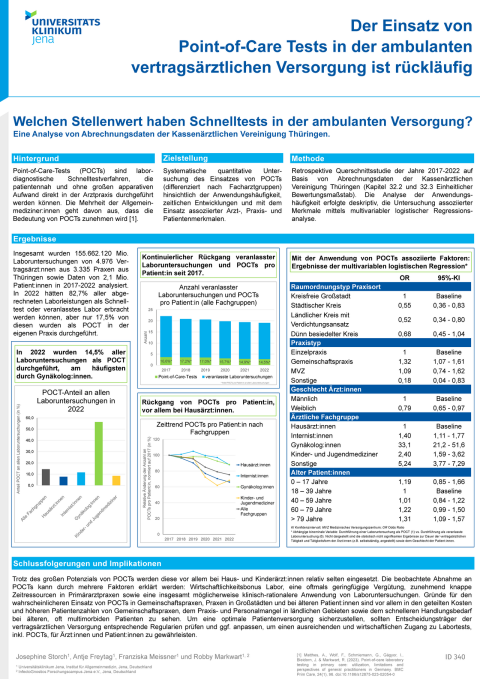
Point-of-care tests (POCTs), also known as rapid tests, are laboratory tests that can be performed in a medical outpatient practice without the need for extensive equipment. They usually deliver results within 30 minutes. Prominent examples include rapid SARS-CoV-2 tests (also known as “coronavirus rapid tests”), urine test strips and rapid pregnancy tests.
The EPoC project aims to systematically analyse the use of POCTs in outpatient care provided by statutory health practitioners. In particular, we want to investigate:
Understanding the current situation regarding POCT use in outpatient care in depth is important for identifying possible over- or underuse and informing targeted activities to improve care.
The planned study is a retrospective, longitudinal, observational study (2016–2021). It is based on outpatient physician billing data (VDX data) from the Thuringia Association of Statutory Health Insurance Physicians, in accordance with Section 295 of the German Social Code V.
The data is transferred to the Institute of General Practice and Family Medicine in a pseudonymised form. This means that any information that could be used to identify physicians or patients is not transmitted. The Thuringian Ministry of Labour, Social Affairs, Health, Women and Family has approved the transfer of this data for research purposes (approval for the transfer of social data for use in research in accordance with Section 75 of the Social Code X).
Trade journals:
Conference:
24. Deutschen Kongress für Versorgungsforschung (DKVF) am 22.-24.09.2024