
Challenges at the Cross-Sectoral Transition from Acute Sepsis Care to Rehabilitation/Aftercare –Results of Guideline-Based Focus Group Discussions
(DKVF 2024)
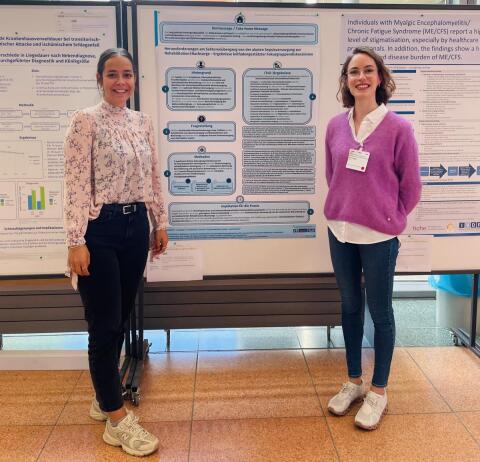
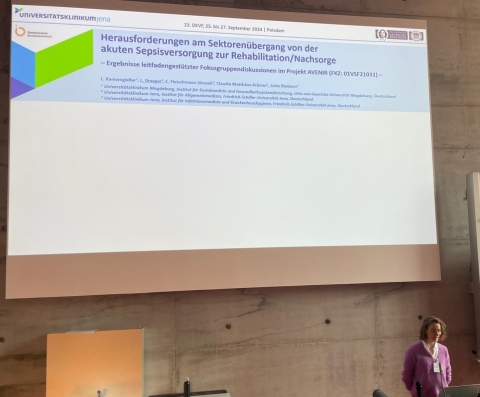
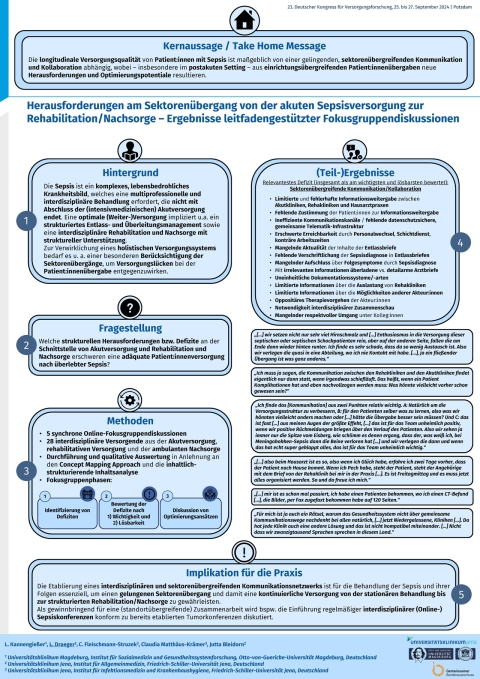
From September 25 to 27, 2024, the 23rd German Congress for Health Services Research took place on the premises of the Potsdam University Campus Griebnitzsee under the motto "Implementation knowledge creates innovative care."Under the category "Results from Health Care Analysis," our research associate Lea Draeger, representing the qualitative AVENIR project team, presented initial findings from an online focus group study in a short presentation and poster session.Together with her project colleague and co-moderator Lena Kannengiesser (Institute of Social Medicine and Health Systems Research, Magdeburg University Hospital), she addressed the following question within the interdisciplinary and cross-sectoral focus group format: Which structural deficits at the interface between acute care and rehabilitation/aftercare hinder adequate patient (follow-up) care after surviving sepsis?The study included neuropsychologists and physicians from specialties such as anesthesiology, intensive care medicine, internal medicine, neurology, physical and rehabilitative medicine, and general practice. To date, little literature exists on the care of sepsis survivors compared to the care of acutely septic patients.One of the numerous findings is that across all focus groups, interdisciplinary and cross-sectoral communication and collaboration among care providers (acute care providers as well as rehabilitation and outpatient aftercare providers) was highlighted as an elementary deficit in the care of sepsis survivors. According to the surveyed experts, this deficit is primarily manifested in limited and/or flawed transfers of (social) medical information and limited exchange or feedback among providers.Identified causes include a lack of data-protection-compliant shared telematics infrastructures and, accordingly, the use of inefficient communication channels (such as fax machines).The establishment of an interdisciplinary and cross-sectoral communication network is therefore described as essential for treating the long-term consequences of sepsis, in order to ensure a successful transition between sectors and thus continuous care from inpatient treatment to structured rehabilitation/aftercare.For instance, the introduction of regular interdisciplinary (online) sepsis conferences, modeled after established tumor boards, is discussed as beneficial for (cross-site) collaboration. The introduction of the electronic patient record is also assessed as very promising for improving the described deficits.A detailed and comprehensive presentation of the results will be available in an upcoming publication.